

Over millennia cultures evolve due to the influx of new people with other cultural habits and ideas that lead to human innovation and creative explorations that led to the evolution of technology, from rock tools to iron tools to computers and more. Through it all humans have recorded their realities, painting and carving our story on rock. Many believe that Ancient African art is limited to Egypt and at best only 5 or 6000 years old despite rock art stretching from Algeria at the top of the continent through South Africa at the bottom attesting to a much longer history of recording spiritual life, flora and fauna that surrounded people, and the rituals of the day be they hunting or dancing or praying.

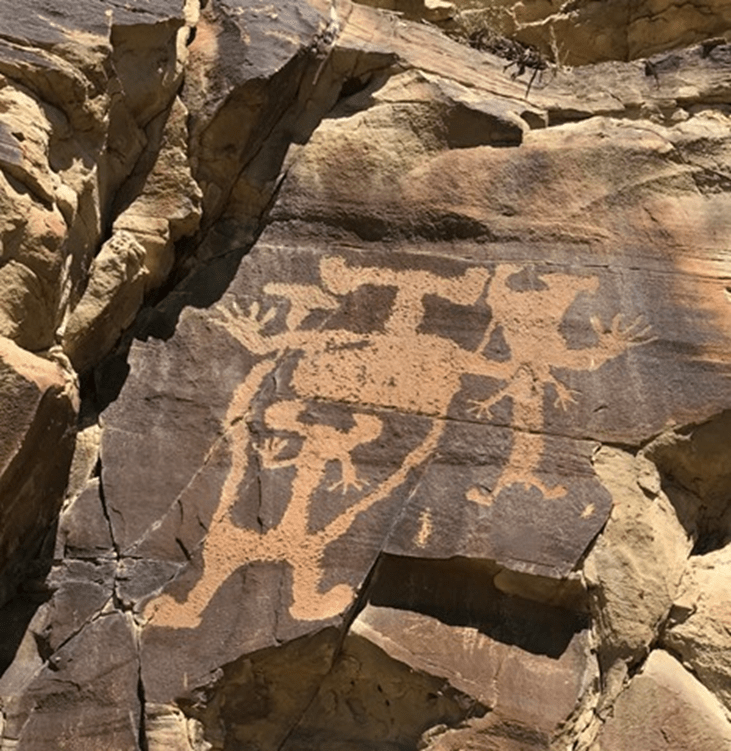
In the United States of America too many people don’t have a good grasp on the idea of history, ancient history, and the stories that have been told for millennia across the globe. In the USA, American history tends to start with one of the invader’s colonization and imperialistic forays, be it the conquistadors in the West or the English and Dutch settlers in the east. Yet indigenous rock painting that reflected the spiritual life of the Indigenous people in the Western Great Basin have art dated to 12,000 years ago.
In Italy there is acknowledgement and a certain pride in the various peoples who came to the land, in exploration, seeking sanctuary, or with an imperialistic goal and left their imprint, from Etruscans, to Saracens, to Africans, to Greeks. Reading in the Northern Italy Archeology museums gave me a long view of human history.
I saw very little of the museum in Vivegano, But several of the cases I did see on my way in and out of the reading corner had artifacts that were thousands of years old including some stunning copper and bronze jewelry. This was the museum where one of the curators talked about her difficulty given the political imperatives of this moment which call for people to push back against genocide, against war, against injustices, but her work was preserving and educating the public to relics from their land dating back thousands of years. I told her that I see a value in considering how humans have survived this long, and calls the question of how we can and should survive in the future. The work of preserving and explaining relics that are thousands of years is relevant in a world full of so much malaise and violence, and an impulse of those currently in power to hide and/or distort the truths of human history, ancient or modern. I opined that history always has a value and it was just a matter of connecting the old with the now. I explained that I was raised in an activist family. One of the values that I was given was that each one had to teach one and tell the one they taught, “Each one has to teach one” and eventually the knowledge that was needed would bear fruit fueling meaningful action.

In Teglio I read in one of the grand rooms at Palazzo Besta. It was built by the Besta family circa 1433. Known for hosting philosophers, writers and artists. They held onto it until the early18th century. It went through a number of wealthy families’ ownership until the Italian state bought it and opened it to the public almost a century ago. Frescos are everywhere depicting the Aenid, other mythologies and replete with illustrations of Bible scripture. The room which I read in still carries the scent of polished wood.

My last reading of the tour was in Cividale. The reading was lovely, but for me the that was most memorable about my day in Valle Camonica was viewing the prehistoric carvings, some dating back 10,000 years, in the 70 year-old Naquane National Park of Rock Engravingswhere over millennia generations came and added their own carvings to the story. Carvings with birds, humans, and deer opened to carvings with symbols of ritual and work, including tools, men with spears, looms where the women wove fabric.
Please note that carved some details of the following images ay be hard to read unless you enlarge.

As in most recorded history, women were mostly absent. My guide, Josie said there was one rock with women’s inner circle that was assumed to be women in some kind of spiritual practice but that yes most if not all of the carvers were men and chose to tell the stories of men.
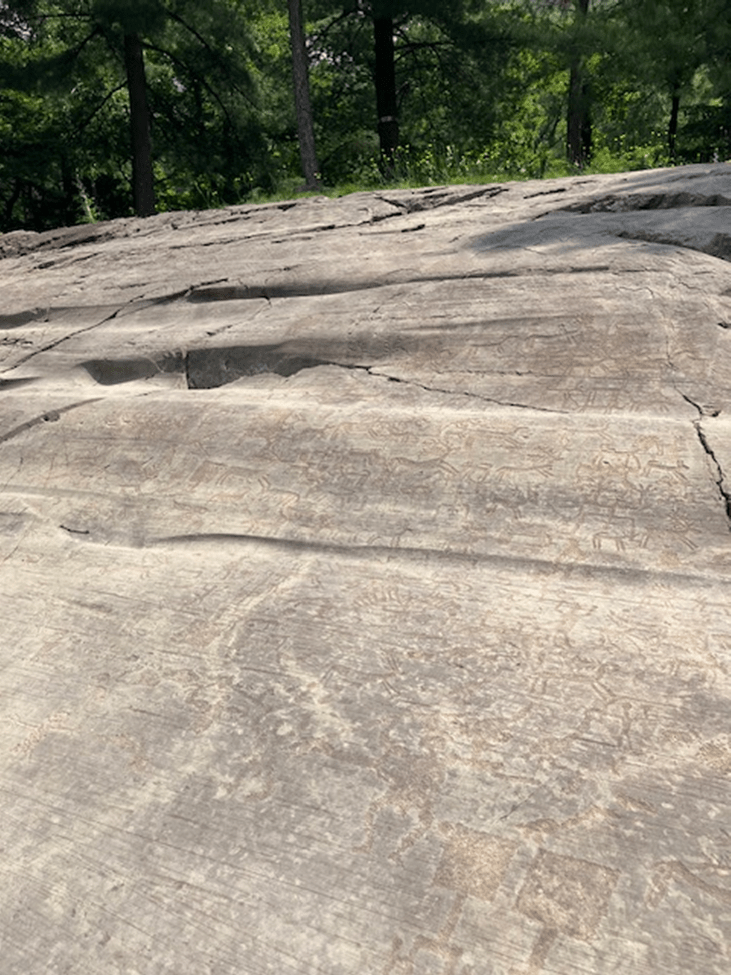
But the planet was telling its own story too with Ice Age markings smoothing some rocks and taking the form of the waves and ice flows that once covered them. While it was easy to see how humans have evolved in terms of technology it was harder to glean an evolution in social constructs. And although these rocks like the other rock art pictures above will be here in 1000 years one wonders what if anything will survive to tell our modern story a millennium from now. All the paintings and photographs on and off the web, film, music recordings might well be gone, indeed most humans gone, but stories always remain to be told across time. How can we tell them in a way that survives our time and technology?
